Have any question?
Call (409) 861-4450

Call (409) 861-4450


Most business owners assume that tighter security requires a slower user experience. They accept friction as the price of safety.
This mindset creates a dangerous paradox: when security is too difficult to use, your team becomes less secure. If logging in requires three different devices and ten minutes, employees will work around you. To eliminate this invisible productivity and security leak, you must remove friction.

During a recent quarterly IT strategy review, a client expressed total confidence that his staff was not utilizing artificial intelligence. However, a review of the company network traffic logs told a different story.

How much of every week do you, or any of your employees, spend seeking out the information needed to get the job done… or trying to, at least, in between all the diversions and distractions. How often have you trawled through your digital storage, only to lose track of your progress when yet another chat notification drags your attention away from… what were you working on again?

How frustrating is it when your computer just doesn’t want to cooperate, whether it takes its sweet time starting up in the morning or decides to go on break in the middle of a meeting? How frustrating it is to see it happening to your team members, fully aware that they are feeling the same frustration you would? How much does it cost you, all events converging over time?
How much of a relief would it be if all these problems stemmed from one source: it being the time to retire that particular piece of hardware and replace it with something new?

For many, the introduction of remote or hybrid work practices was less of a choice and more of an existential need. Now, years after certain events caused this existential need, there are still pockets of friction that appear and make these approaches to work far more challenging than they can and should be.
Let’s explore a few of these pockets of friction and even more crucially, how to smooth them over.

Business owners often make technology investments in a vacuum. You look at the metrics, you see the potential return on investment, and you purchase the platform. Two months later, everyone is still quietly reverting back to their old spreadsheets. You might want to mandate the new software and lock down the old files, but mandating the platform is not the core issue. The problem is that your team does not see the tool as a way to make their workdays easier.

How much does a 5-second lag on your technology cost? Most business owners will look at an aging laptop and think, “It still works, so why replace it?” The reality is that older devices can lead to a silent, invisible drain on your budget that doesn’t show up on the hardware invoice: the labor leak.

I've been playing around with these tools a lot lately, and I'll be the first to tell you: most of the AI content out there is just noise. It’s generic, it’s soul-less, and it usually starts with some variation of “In today's fast-paced digital landscape…” (Which, let's be honest, is an immediate signal to stop reading).

The problem with a lot of businesses is that they certainly don’t lack for software; they lack a strategy.
We often see business owners treat software like a grocery list. They realize they're hungry for a solution, they go out and buy the first shiny ingredient they see in an ad, and then they wonder why their kitchen is a mess and they still can't make a cohesive meal. Buying software without a strategy is just expensive clutter. Let's look at how to actually build a stack that helps your team instead of giving them app fatigue.

Running a small business is often romanticized as a scrappy adventure, a series of late nights and breakthroughs, but anyone actually in the trenches knows it’s more like trying to repair a plane while it’s hurtling through the air at thirty thousand feet than it is a pleasant stroll in the park.

There is a dangerous phrase that often precedes a crisis: “...But it is still working fine.”
Viewing technology as a one-time purchase or a fix-it-when-it-breaks utility is a recipe for stagnation. If you are not consistently investing in your digital infrastructure, you are not just standing still; you are falling behind. This lack of movement creates a widening gap between your capabilities and the expectations of the people that depend on your business.

We all know that person who is just a little too comfortable with artificial intelligence. The one that is always talking about—and to—the LLM they use. The one that is always mentioning the prompts they created.
The danger isn't just that the AI is smart; it’s that the AI is extremely sycophantic. It is programmed to agree and to validate. When a chatbot stops challenging you and starts reinforcing your every whim, you aren't gaining an assistant, you’re losing touch with reality.

It’s a common scene in many offices: the accidental IT person. They were hired to handle your marketing or manage your sales, but because they happen to know how to fix a printer or reset a password, they’ve become the unofficial tech support.
While this might seem like a quick fix, it’s actually a silent growth killer for your business. Here is why relying on the office tech whiz is holding you back; and how a professional approach can fuel your success.
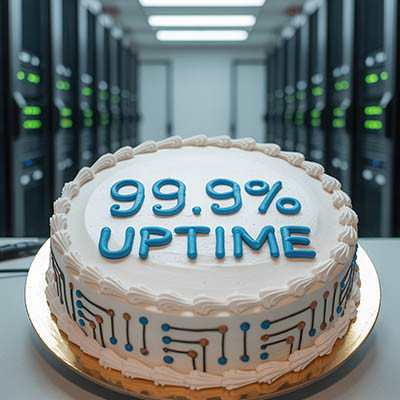
Project yourself one whole year from today. Now imagine that you’ve maintained 99.9 percent uptime for the entire year. What would a year of relentless, focused expansion do for your business compared to having your progress stymied at every turn by constantly fighting with your technology?

The promise is seductive: one login, one monthly bill, and every tool your business needs under a single digital roof. It sounds like productivity nirvana, but for many growing teams, it’s actually a heart-shaped box.
Here is why the all-in-one software suite is often a lie, and why the Best-of-Breed approach is making a massive comeback.

Misplacing a file can be annoying and stressful, especially if that file is important. On complex networks, it could potentially be in multiple different locations, perhaps on a local network device or somewhere in the cloud. In moments of dire need, knowing how to locate such important files makes you a standout (and standup) employee, so let’s explore ways to find “lost” files, even if they’ve seemingly disappeared into the ether.

The pace of technology hasn't just increased; it has fundamentally changed how we interact with the world. We are no longer just using computers; we are collaborating with autonomous agents and managing vast digital ecosystems.
To help you stay ahead of the curve, here are four essential technology tips to boost your productivity, secure your data, and protect your mental well-being this year.

If you’re a business owner, you likely view IT as a necessary evil. It’s that line item on your profit and loss report that feels like a black hole; money goes in, and occasionally, your printer still doesn’t work.
The hard truth is that if you are still calling a tech person only when things break, you are paying a hidden tax on your own growth.

You’ve seen the demos. Dashboards filled with green bars, heatmaps of employee activity, and productivity scores that promise to tell you exactly who is working and who is watching Netflix.
To you, it’s monitoring: A way to protect your assets and ensure you’re getting what you pay for. To your team, it’s spying: a digital leash that says, "I don’t trust you to do the job I hired you for."

Does the thought of a sudden system crash keep you up at night? It should, but not for the reason you might think.
While a disaster is the initial shock, it’s the prolonged downtime that follows that truly cripples a business. It’s a slow-motion drain on your resources, and without a proactive strategy, those lost minutes can quickly translate into thousands of dollars in wasted overhead.
Get the Knowledge You Need to Make IT Decisions
Technology is constantly evolving, and keeping up can feel overwhelming. Whether you want to understand cybersecurity threats, explore automation, or learn how regulations like PCI DSS impact your business, we’ve made it easy to access clear, straightforward insights on key IT topics.
Learn more about what NetWorthy Systems can do for your business.
NetWorthy Systems
701 W. Division Ave Suite 100
Orange, Texas 77630